How to Choose a Bottle Nipple For Your Baby

Feeding babies is big business. There are dozens of companies competing for a spot in your kitchen cabinets—and your wallet—which makes choosing a bottle feel way more complicated than it should.
But here’s the truth: the best bottle for your baby is not the one that looks the most like a breast. It’s the one that supports your baby’s mouth mechanics.
In this guide, you’ll learn how to choose a bottle based on nipple shape, flow rate, and compatibility—so you can avoid common (and expensive) bottle mistakes and support feeding whether you’re breastfeeding, combo feeding, or bottle feeding full-time.
Quick Answer: What Bottle Should I Choose?
If you’re overwhelmed and just want the short version, here’s what matters most:
- Choose a bottle that encourages a wide gape
- Look for a gradual transition from base to tip
- Choose a slow flow nipple (and don’t assume “slow flow” is truly slow)
- Watch for stable suction (no clicking, leaking, or sliding shallow)
- Choose what works inside your baby’s mouth—not what looks good on the shelf
Ignore bottles that claim they’re “more like breastfeeding” based on appearance alone.
Because what matters isn’t what the bottle looks like sitting on the shelf.
What matters is what happens inside your baby’s mouth.
If you want to understand "the why" or how to feel more confident in making these choices, keep reading
Tip #1: Recognize the Bottle Marketing Trap
Marketing experts know one thing about parents: you will do almost anything to give your baby the best start.
And because many parents want to breastfeed or chestfeed, bottle companies often use emotionally loaded language like:
- “Closer to the Breast”
- “More like Breastfeeding”
- “Designed for Breastfed Babies”
- “Breastfeeding-Friendly”
This is a highly effective marketing strategy, because it makes you feel like you’re choosing the bottle that protects your breastfeeding relationship.
But here’s the catch:
Most bottles make these claims based almost entirely on what the bottle looks like on the outside.
Many “breast-like” bottles have a wide base and a tall nipple. And yes—when you look at them sitting on the shelf, they may resemble the breast.
But that’s not what matters.
What your breast looks like inside your baby’s mouth is completely different.
When your baby latches to the breast or chest, they don’t just take the nipple.
They take the nipple, the areola, and breast tissue into their mouth too.
And once that tissue is inside the mouth, it changes shape dramatically.
A bottle nipple doesn’t do that.
It stays the same shape the entire time.
So even if a bottle looks breast-like on the outside, it often doesn’t behave anything like the breast once feeding begins.
The right bottle is the one that makes feeding easier for your baby—not the one that makes you feel reassured by the packaging.

This is what breast tissue looks like inside a baby’s mouth. Bottle nipples don’t change shape this way—no matter how “breast-like” they look on the shelf.
Tip #2: Babies Drink From a Bottle Like You Drink From a Straw
No matter what bottle you choose, bottle feeding will never be identical to breastfeeding.
That’s because babies use different muscle patterns at the breast than they do on a bottle.
Here’s the easiest way to understand it:
Breastfeeding is like drinking from a cup.
Bottle feeding is like drinking from a straw.
You use different oral muscles to drink from a straw than you do to drink from a cup.
And your baby uses different oral mechanics to feed from a bottle than they do to feed from the breast.
This is why many families are advised to wait until breastfeeding is going well before introducing bottles (when possible).
It gives babies time to build the muscle coordination for breastfeeding first.
But if your baby needs bottles early, that doesn’t mean you’ve ruined anything.
It just means we want to choose a bottle that supports healthy feeding patterns as much as possible.
Tip #3: Every Feeding Teaches Your Baby’s Mouth What to Do
This is one of the most overlooked parts of feeding.
Every time your baby feeds, their brain is learning.
They’re building muscle memory for what feeding “should” feel like—and what their mouth needs to do to get milk.
That’s true whether your baby is feeding from breast/chest, bottle, pumped milk, or formula.
Every feeding teaches the mouth what to do next.
So when your baby repeats feeding patterns that support breastfeeding, those patterns become easier over time.
And when your baby repeats feeding patterns that don’t support breastfeeding, those patterns become easier too.
Why a wide mouth matters
One of the most important feeding skills a baby needs for comfortable breastfeeding is the ability to open their mouth wide before latching.
You may have heard this described as a “wide gape.” But all it really means is this:
A wide latch starts with a wide mouth.
When a baby’s mouth stays narrow or tight, they tend to latch shallow—which can lead to:
- Latch pain
- Nipple damage
- Clicking sounds
- Milk leaking
- Poor milk transfer
Even if your baby starts out latching well at the breast, frequent bottle feeding with a narrow mouth position can reinforce that same narrow pattern.
Because your baby’s mouth learns what to do through repetition.
That’s why bottle choice matters.
Not because bottles are bad… but because bottle feeding can either encourage a baby to open wide, or reinforce a shallow latch pattern.
Bottle feeding can support breastfeeding mechanics—or unintentionally train the mouth away from them.


This baby has a wide mouth (or gape) on the bottle. This will support a deeper latch.
How to Choose a Bottle Based on Shape
Even though bottle feeding will always be different than breastfeeding, you can choose bottles that make it easier for your baby to feed with a wide, stable mouth position.
To understand this, go back to the straw analogy.
When you drink from a straw, you use your tongue to stabilize the straw inside your mouth.
Now imagine trying to drink from a straw that sits half an inch away from your tongue.
That would feel awkward and ineffective.
Your tongue needs to contact the straw.
Your baby needs the same thing.
A bottle nipple should allow the tongue to stay in contact with the nipple while still allowing a wide gape.
The biggest shape difference that matters: Abrupt vs Gradual
Many bottles are marketed as “better for breastfeeding.”
But there’s one design feature that matters far more than marketing claims:
Does the nipple have an abrupt transition… or a gradual one?
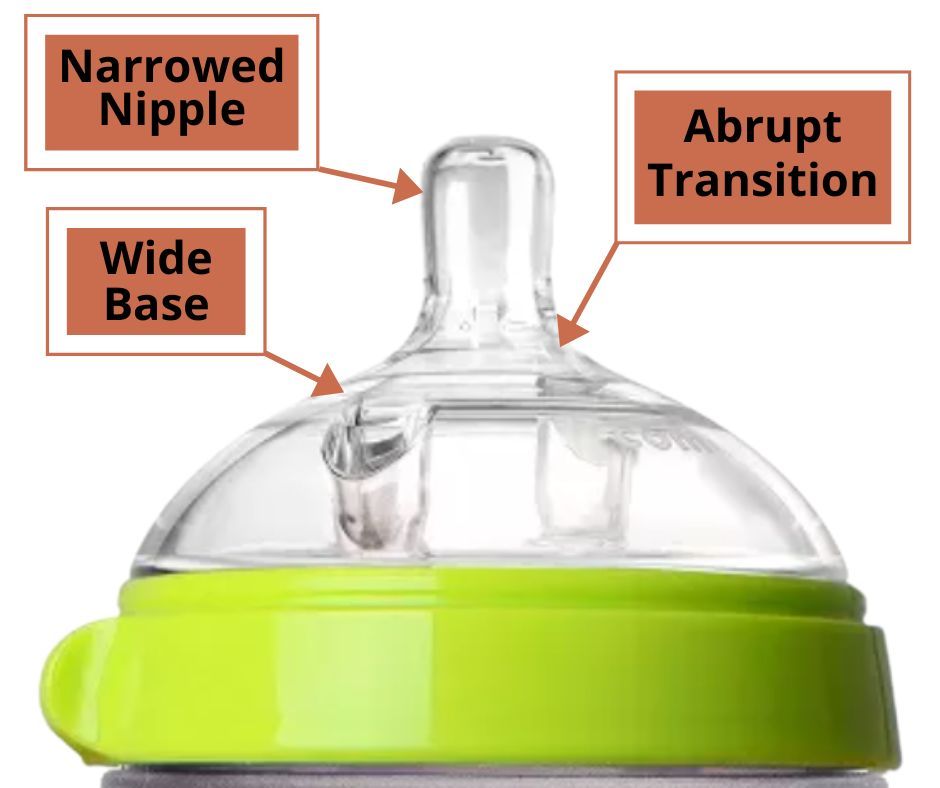
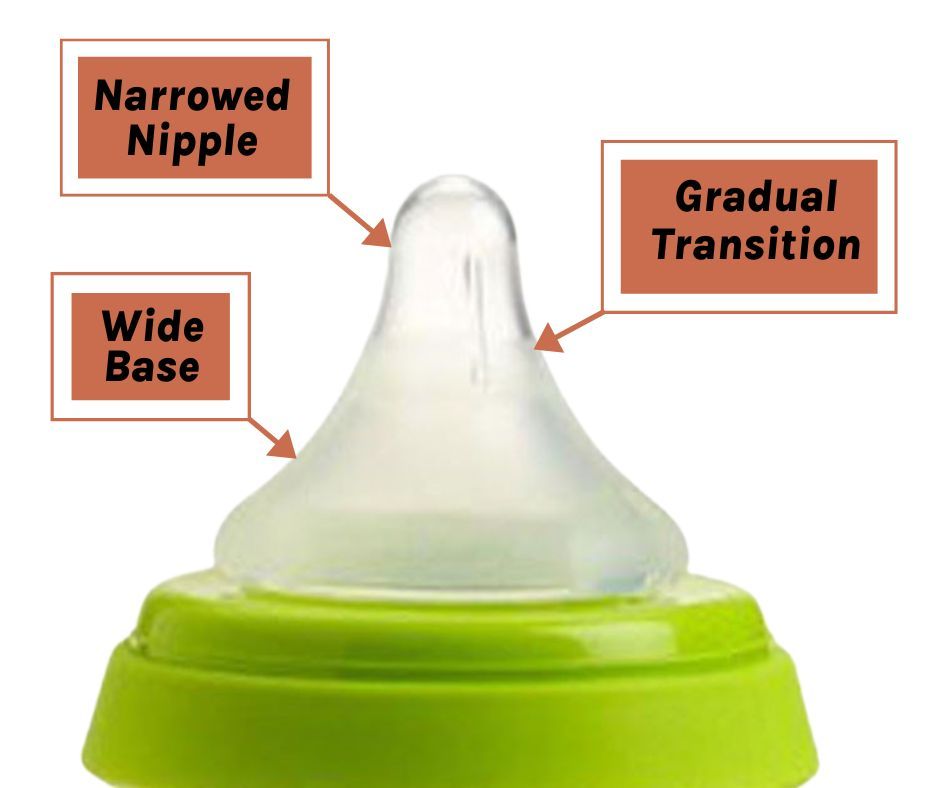
A bottle with a gradual transition from base to nipple can help a baby get a deeper, more comfortable latch.
Bottle Type #1: Abrupt transition from base to tip
Some bottle nipples have a sudden change between the wide base and the narrow nipple.
When your baby tries to gape widely and get their mouth onto the wide base, the nipple may end up several millimeters away from the tongue.
And because babies need tongue contact to generate suction, what happens next is predictable:
They slide backward.
What may start as a wide gape often ends with the baby feeding on the tip of the nipple instead, creating:
- A shallow latch
- A narrow gape
- A weaker seal
Even though these bottles may look breast-like on the outside, they can unintentionally encourage shallow feeding mechanics.
That doesn’t mean they’re “bad bottles.”
But it does mean they don’t always support the wide gape pattern we want for breastfeeding.
Bottle Type #2: Gradual transition from base to tip
Some bottle nipples have a gradual, smooth transition from the base of the nipple to the tip.
This shape makes it easier for the tongue to stay in contact with the nipple even when the baby opens widely.
That means your baby can maintain:
- A wider gape
- A deeper latch on the bottle
- More stable suction
Even if this nipple doesn’t look as “idealized” on the shelf, it often supports better mechanics inside the mouth.
And inside the mouth is where feeding happens.
How to Choose a Bottle Based on Flow Rate
The other major factor in bottle selection is flow rate.
Flow rate is how quickly milk comes out of the bottle.
And flow matters because:
The faster the flow, the easier it is to drink.
Just like a wide straw makes drinking easier, a fast bottle nipple reduces the amount of work your baby has to do.
And babies notice that.
This is often what people mean when they talk about “nipple confusion.”
Babies aren’t confused about what the bottle is.
They simply learn that one option is easier.
The problem with “slow flow” labels
Unfortunately, “slow flow” is not standardized.
There is no industry-wide definition.
So the slow flow nipple from one brand may be dramatically faster than the slow flow nipple from another.
You can’t tell how fast a nipple is just by looking at it.
This is why flow comparison charts can be helpful when selecting bottles.
Do breastfed babies need to size up nipples over time?
This is one of the biggest myths in bottle feeding.
Bottle companies often market nipples as “Stage 1,” “Stage 2,” “Stage 3,” or “0–3 months,” “3–6 months,” etc.
But breastfed babies don’t need faster nipples as they grow.
Your milk flow doesn’t automatically increase as your baby gets older.
So most combo-fed babies can stay with the same slow-flow nipple for their entire bottle-feeding period.
You do not need to keep sizing up unless your baby truly needs it for a medical or feeding reason.
A quick word about “bottle variety packs”
You’ll also see bottle “variety packs” marketed as a way to help you find the best bottle for your baby.
And in theory, that sounds helpful.
But in practice, many variety packs aren’t actually offering meaningful variety.
Most of the bottles included are still built around the same basic nipple design, with similar shallow latch mechanics.
So what you often end up with is not a true trial of different options…
It’s ten versions of the same nipple shape with different branding.
If you want to experiment, you’re usually better off choosing a few nipples that are structurally different (especially gradual vs abrupt shapes) rather than buying a bundle that looks “varied” but feeds the same way.
Or, if your baby is struggling with bottle feeding, reach out to an IBCLC who has training with bottles too.
Bottle Comparison Chart
This is just a sample of some of the gradual neck nipples I have personally used. Thankfully, there is a much wider variety of gradual neck bottle nipples and sizes than there was when I wrote this blog originally in 2022, so you have more options.
However, the speed of the flow still matters, and this is where there may be a lot of variation.
| Bottle Brand | Slow Flow Rate | Nipple Shape | Glass Size Options | Cost |
|---|---|---|---|---|
| Lansinoh Momma (Natural Wave) | Medium | Gradual | 5 and 8oz | $ |
| Pigeon Peristaltic | Slow | Gradual | 5 oz, 8 oz | $$$ |
| Dr. Brown's Narrow | Wide Variety | Narrow, Gradual at base | 4 oz, 8oz | $ |
| Even Flow Balance | Slow | Gradual for most of base | 5 oz & 9oz | $ |
| Guicola | Fast | Gradual | 3 oz, 5 oz, 8oz | $$$ |
Bottle Compatibility + Air Vents: What to Know Before You Mix and Match
Once you understand bottle shape and flow rate, the next question most parents ask is:
“Can I use this nipple with a different bottle?”
And the answer is: sometimes, yes.
Mixing and matching can be a great strategy if you’ve found a nipple your baby feeds well from, but you want a different bottle base (glass vs plastic, different size, easier to wash, etc.).
But there are a few things you need to know before assuming that “compatible” means “safe and functional.”
Compatibility means two different things
When it comes to bottles, compatibility doesn’t just mean that the nipple screws onto the bottle.
It actually means two separate things:
- It seals correctly (no leaking, wobbling, or loose threading).
- It still functions correctly (milk flows normally and the bottle vents properly).
Some nipples will technically attach to a bottle, but the threading isn’t a perfect match. That can lead to leaking or poor suction.
And even if a nipple screws on and seems to fit well, it still may not work correctly if the bottle isn’t able to vent.
Yes — glass and plastic versions are usually interchangeable
If a nipple fits the plastic version of a bottle, it will usually fit the glass version too.
That’s because the threading on glass bottles is typically designed to match the same brand’s plastic bottles.
So if your baby feeds well with a certain nipple, you can often keep the nipple you like and choose the bottle base you prefer.
Bottles need air vents to work
For milk to come out of a bottle, air has to be able to come in.
As your baby drinks, milk leaves the bottle, and something has to replace that space. If air can’t enter, a vacuum forms.
That means a baby can suck and suck… and get almost no milk.
If milk isn’t moving, your baby may be sucking correctly—but the bottle may not be venting correctly.
This can look like:
- Your baby working hard but getting frustrated
- Long feeds with very little milk transfer
- Repeated unlatching
- A bottle nipple collapsing inward while your baby sucks
If you notice the nipple collapsing, that’s often a sign that the air vent is pinched, blocked, or not functioning properly.
So if you’re using a new bottle setup (especially a mixed-brand setup), always watch closely to make sure milk is actually moving.
If your baby is sucking but milk isn’t leaving the bottle, the first thing to check is the air vent.
Common compatibility examples (but always double check your setup)
Here are a few common compatibility patterns parents use when trying to avoid buying a full “proprietary” bottle system:
- Lansinoh bottles and nipples are often compatible with Pigeon, Gulicola, and Spectra nipples, and may also work with Evenflo Balance nipples (but always monitor venting and milk flow).
- Dr. Brown’s Regular Neck bottles can sometimes work with other regular neck nipples only if the internal vent system is not being used.
- Pigeon wide-neck bottles and nipples are often compatible with other wide-neck systems (including Lansinoh-style threading).
- Comotomo, Tommee Tippee, and NUK Simply Natural are often less interchangeable because they use more proprietary nipple shapes and collars.
- Kiinde systems can be compatible with multiple nipple brands, but usually require specific adapters or collars.
These compatibility patterns can be helpful, but always remember: even if something screws on, your baby still needs a stable seal and a working air vent.
Bottom Line: The Best Bottle is the One That Best Supports Feeding for Your Baby
If you’re getting ready to introduce a bottle and you’re worried about messing up breastfeeding, you’re not being dramatic.
Bottle feeding can feel like one wrong move will undo everything you’ve worked for.
But bottles don’t “ruin” breastfeeding.
What matters is the match between your baby’s mouth and the bottle you choose—and how feeding happens once the bottle is in their mouth.
The best bottle is not the one that looks the most like a breast.
The best bottle is the one that supports your baby’s mouth mechanics: a gradual nipple shape, a manageable flow, and a stable seal without clicking, leaking, or sliding shallow.
That’s what helps your baby keep practicing the same wide-mouth feeding skills they use at the breast.
And just as important as the bottle itself is pacing. Even a great bottle can cause frustration if feeds are rushed or unpaced. Paced bottle feeding (slow, supported, with pauses) helps your baby stay organized, protects breastfeeding mechanics, and reduces the risk of preference patterns.
Because what matters isn’t what the bottle looks like on the shelf.
What matters is what your baby’s mouth has to do to feed from it—and how you guide that experience.
Go Deeper → If you want a step-by-step plan for introducing bottles in a way that supports breastfeeding (without stressing over every decision), read: How to Prevent Nipple Preference — Without Stressing Over Every Bottle
Want More Support?
If this blog was helpful, here are a few related posts you might like.
➜ Does Your Baby Have a Good Bottle Latch? Here's How to Tell
➜ How Much Breastmilk Does My Baby Need Per Day?
🔒 Go Deeper: How to Prevent Nipple Preference—Without Stressing Over Every Bottle
🔒 Expanded Access resources go deeper to help you solve your latching and feeding problems. Click here to learn more about what's inside.
Frequently Asked Questions